What is changing with the Code and why?
In response to a wave of Oregon state legislation aimed at addressing the housing shortage, all cities and counties are required to comply with new state laws. These legislative changes are designed to make it easier and faster to build more types of housing, primarily middle housing, single-room occupancies (SROs), and accessory dwelling units (ADUs). These changes are aimed at residential development across cities and counties, particularly in neighborhoods that were previously limited to single-family homes. Additionally, local governments are now limited in the criteria they can apply to residential development to avoid imposing restrictions that reduce housing density and are required to streamline residential land use review processes.
The update process for Hermiston involves allowing additional housing types in residential zones, implementing or revising development standards for various housing types, and updating applicable review procedures to most residential-related land use applications. To comply, the Hermiston Municipal Code, and likely the Hermiston Comprehensive Plan, will be updated to directly implement legislative changes to housing-related land use legislation.
Why are we going for large city requirements?
The City of Hermiston is growing faster than both Umatilla County and the state overall and is rapidly approaching a population of 25,000. This population threshold is the point at which state housing regulations (OAR 660-046) classify a city as “large” and impose additional requirements on housing types and development standards. To avoid a second round of code amendments once that threshold is crossed, the City is opting into updating the Municipal Code now to proactively address those requirements.
MIDDLE HOUSING
Middle Housing consists of duplexes, triplexes, quadplexes, cottage clusters, or townhouses (ORS 197A definition) and must be allowed anywhere a single-unit home is permitted. For Hermiston, all residential zones (R-1, R-2, R-3, R-4, and R-R) need to be amended to allow all middle housing types. Middle housing will also have some limitations on the types of standards which are applicable, and the code will be updated to reflect these limitations.
Middle Housing Types
See below for a more detailed description of each middle housing type, as well as some example developments within each category. These examples illustrate the variety of choice, affordability, and design that can come with middle housing development. They also demonstrate that these “new” types of housing have long existed in most cities, including Hermiston! What’s changing is that these housing types will now be explicitly allowed in all residential zones.

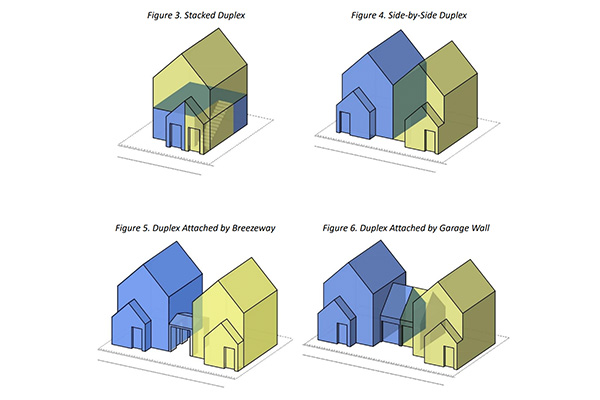
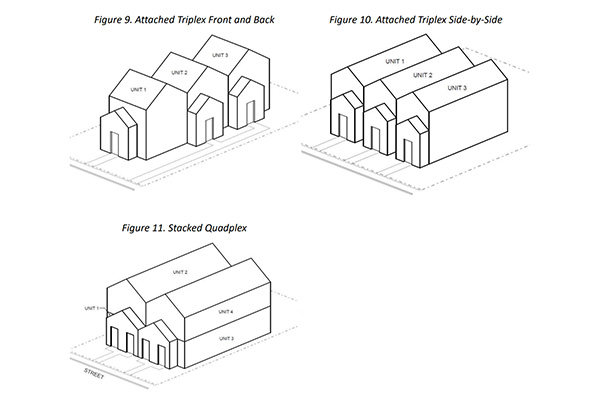
Plexes (Duplex, Triplex, and Quadplex)
Multiple units, typically inside one structure, on a single lot. Usually, each unit has its own entry.
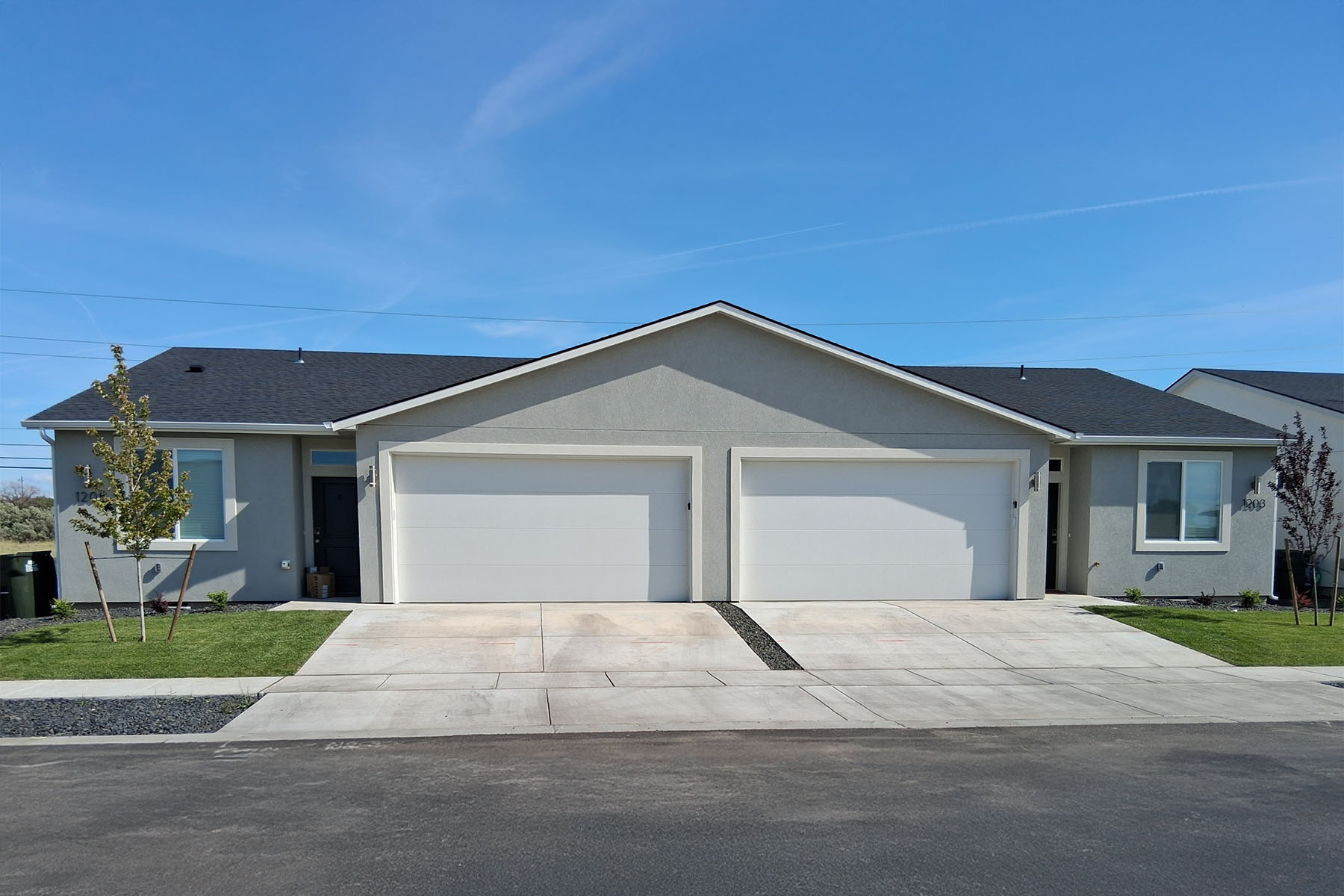
Example Image: Local Hermiston duplex

Cottage Clusters
Small, single-level, typically detached units, often on their own lots and sometimes clustered around pockets of shared open space. A cottage is typically under 1,000 square feet in footprint.
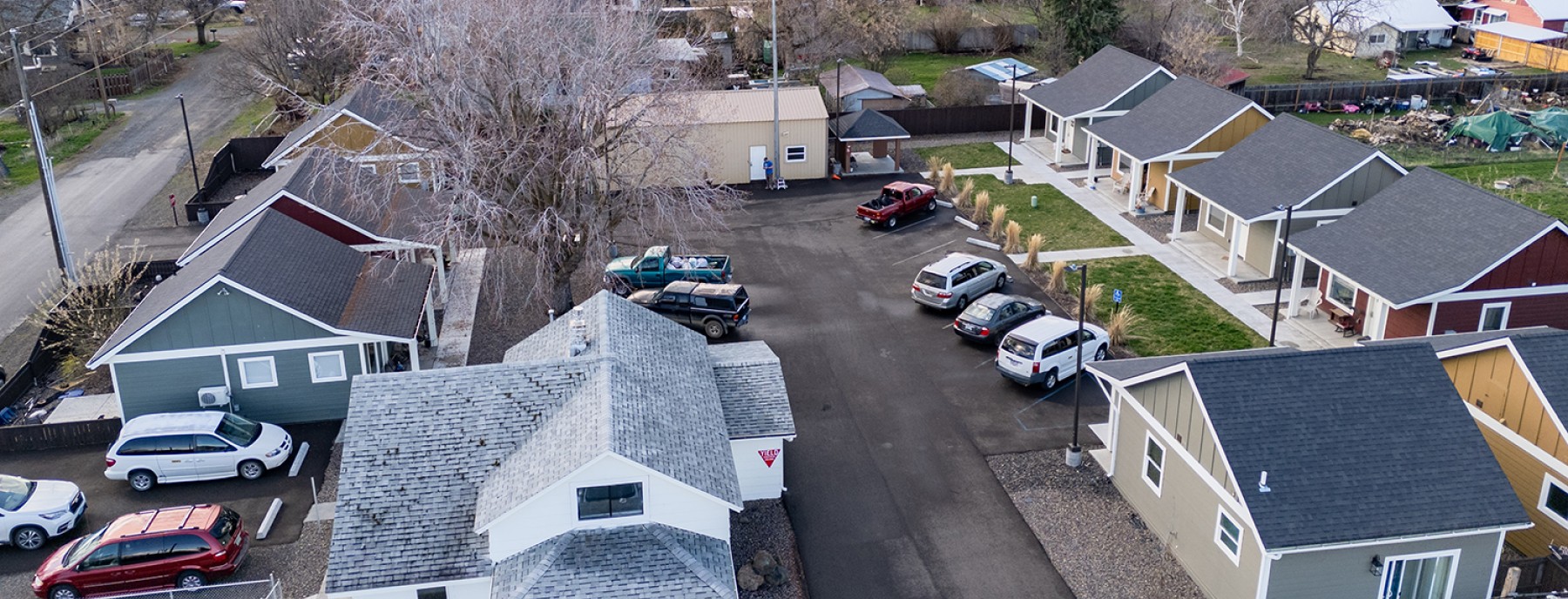
Example Image: La Grande Veteran Village Cottage Cluster

Townhouses
Attached units, each on a separate lot, and each with its own entry from a public or shared street or common area.
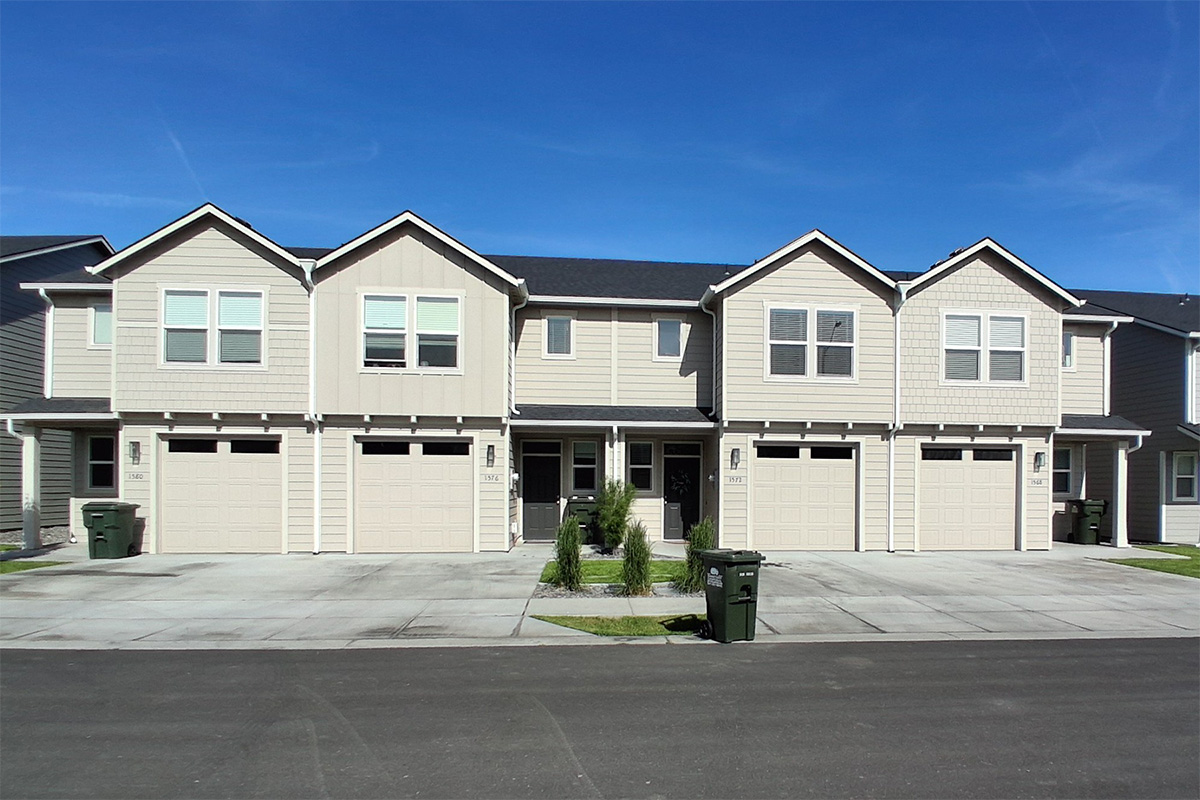
Example Image: Local Hermiston townhouses
Middle Housing Types must be allowed in a variety of configurations, such as stacked units upstairs and downstairs, side-by-side units similar to a townhouse, or units with mixed orientations to maximize lot access and use. Additionally, any middle housing development may also propose “bonus” units if affordable or accessible housing meeting the required criteria are included in the proposal.
Hermiston will implement development standards based on the DLCD Large Cities Middle Housing Model Code, which provides guidance on which standards may be applied to middle housing and which may not.
Image source: Model Code
Middle Housing Land Divisions (MHLD)
Legislative changes also require that middle housing land divisions be allowed to happen via an expedited process, and be processed at the same time as a subdivision application.
Image sources: Model Code, City of Eugene, City of Portland
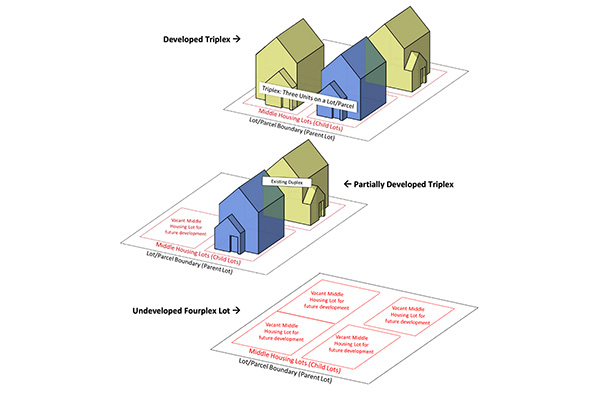
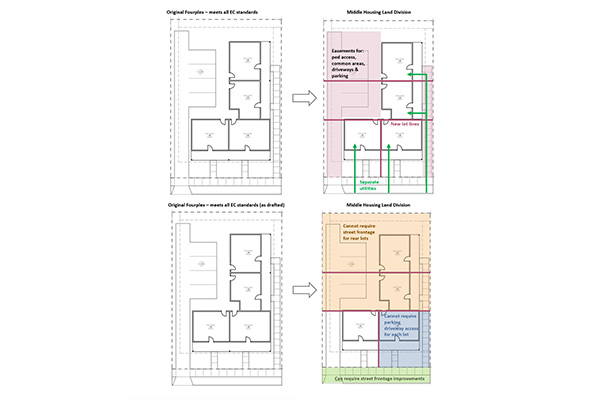
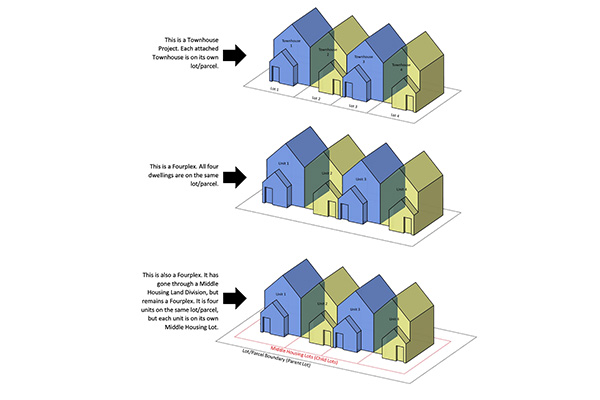
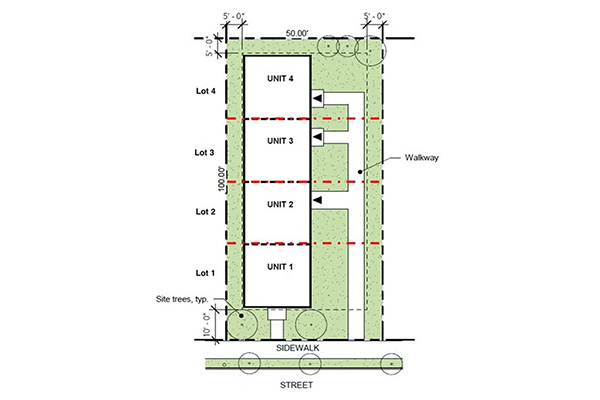
MHLDs provide a simplified and expedited process for subdividing or partitioning lots with middle housing so that each unit is on a separate property, enabling individual sale and ownership.
BEYOND MIDDLE HOUSING TYPES
In addition to middle housing types, state legislative changes also reduce barriers for ADUs, single-room occupancies, multi-unit (i.e. apartments), and all residential development.
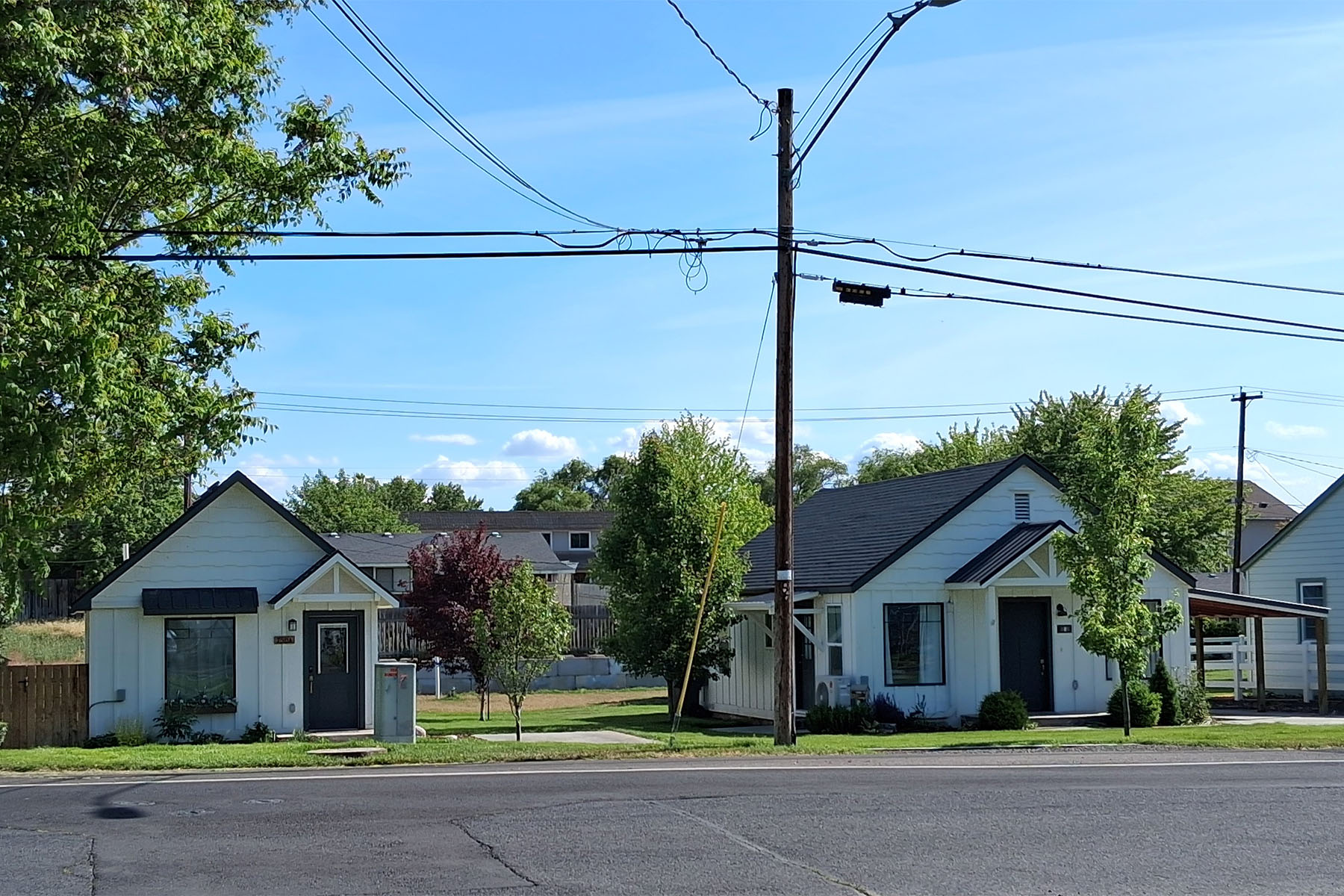
ADUs are small living spaces located on the same lot as a single-dwelling structure. They must be allowed in attached or detached configurations, and can also be located in an existing accessory structure (such as above a garage.
Example Image: ADU in Hermiston

Where multi-unit dwellings are allowed is mostly unchanged by the state law changes. However, all residential development must be made under standards that are “clear and objective.” These are standards that are written in plain, specific, and measurable terms.
Hermiston will also implement development standards for multi-unit development in accordance with the DLCD Large Cities Middle Housing Model Code.
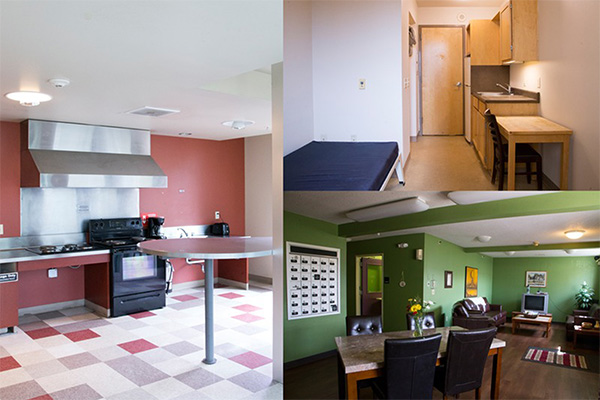
Single-room occupancies are developments with at least four privately lockable rooms for rent, each used for living and sleeping, where residents share bathrooms and/or kitchen facilities. This could look like a building layout similar to a college dorm, a house that rents out rooms individually, or a hotel converted for residential use.

Commercial land may be used for affordable residential development subject to an affordable housing covenant (ORS 456.270 to 456.295)
OTHER CODE UPDATES
Apart from allowing middle housing and other housing types, this code update also addresses the following changes to state law:
Statutory Procedures are being updated in a number of ways:
1. A number of residential application types are required to be reviewed as a “limited land use decision” or a similar administrative review. Generally, this means no hearing is required for the initial decision, and the radius of public notice is limited to 100 feet. These include:
– Tentative Subdivisions or Partitions
– Replats
– Lot Line Adjustments
– Expansion, Extension, or Alterations of Non-Conforming Uses
– Residential Variances
– Planned Unit Developments
– Residential Upzoning
– Applications for Residential Development Under Clear and Objective Standards
2. Hermiston must allow a subset of adjustments to residential applications when criteria are met.
Manufactured Housing cannot have any standards that would not apply to a traditional “site-built” home.
Family Child Care Homes are child care facilities within a residence. They are treated as a residential use and permitted in all residential zones.
Child Care Centers may be located alongside institutional uses in residential zones and are also allowed in commercial, and light industrial zones.
Clear and Objective standards are required for all residential development, which is a path to land use permitting that does not require the City’s discretion or judgment. Essentially, straightforward and direct standards. A general review of the code has identified several mostly minor changes to ensure a clear and objective path for housing applications.
Revised Emergency Shelter Siting code standards.
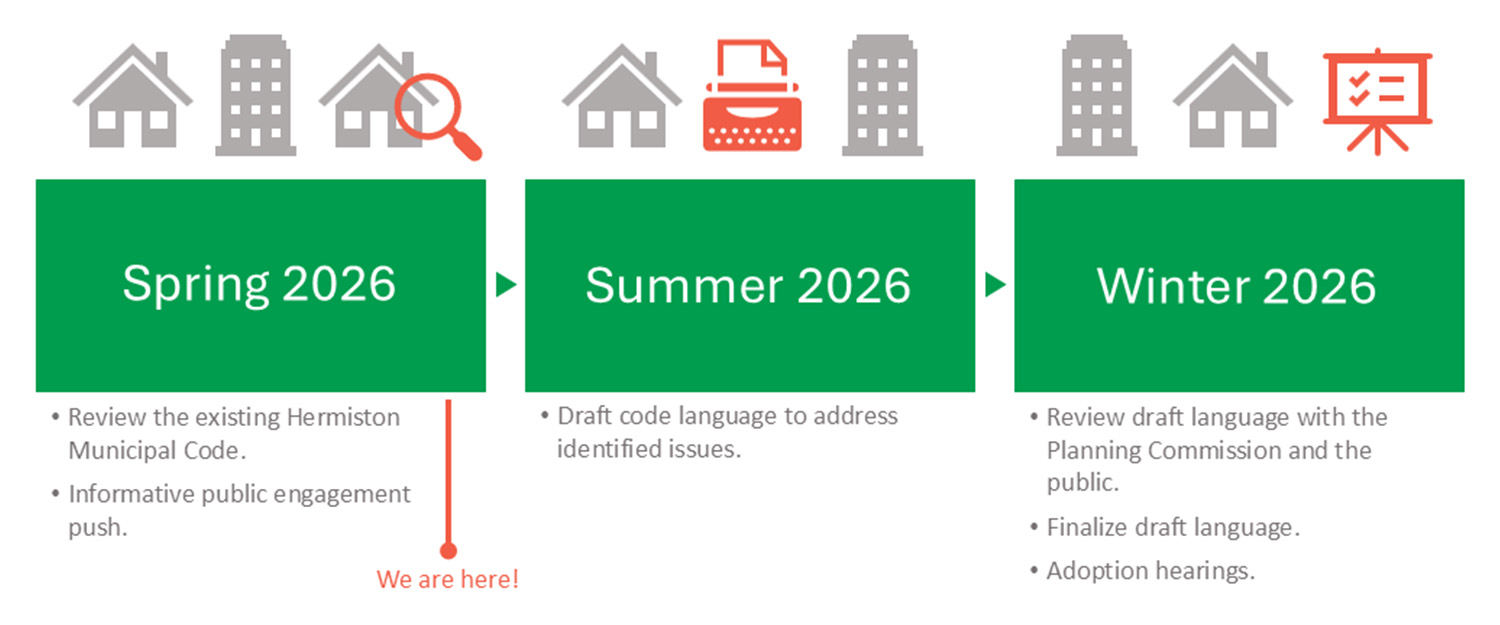
TIMELINE
CONTACT
The community is a key part of this Code Update. Residents can ask a question or provide feedback by emailing housing@hermiston.gov.
A public work session with the Hermiston Planning Commission is planned for the fall, where the community can learn more and provide input on proposed code changes.
More details on this work session will be posted here when scheduled.